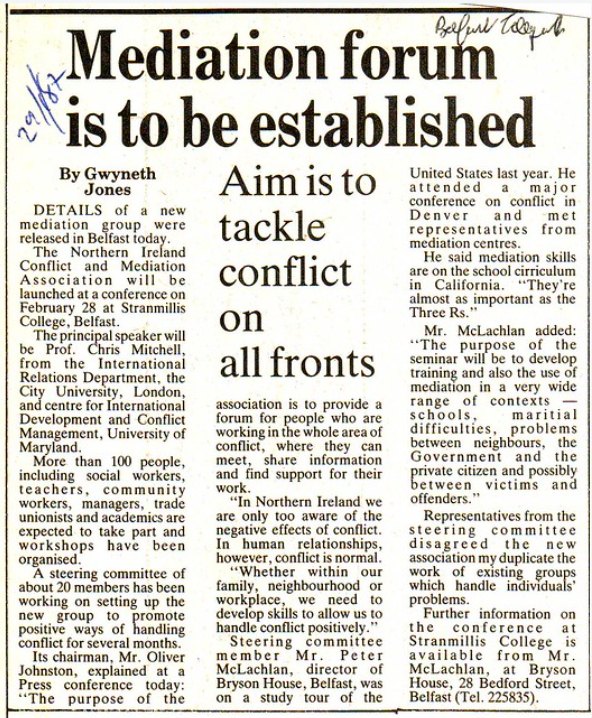
Mediation Northern Ireland began as an association of people seeking an alternative approach to the conflict experienced in Northern Ireland in the late 1980s. What follows is a walk through the archive: the moments, the people and the photographs that made the organisation what it is.
The first decade
Brendan McAllister and Clare Morrison were the first full-time staff, in 1992. Brendan described the evolution of mediation in Northern Ireland over a decade or more as four stages:
- beginning with the importation of learning from American mediators;
- then a process of inculturation, where we found Northern Irish language for American ideas;
- then indigenation, where we distilled the Northern Irish approach to conflict and shaped our own mediation model;
- and maturing to a point of mutuality, where we were ready to open up again to others, now with something to contribute and share internationally.
Mediation Northern Ireland owes a deep debt of gratitude to all those who contributed to our foundations, including Adam Curle, Sue and Steve Williams, Mari Fitzduff, Jerry Tyrrell, Doug Baker, and John and Naomi Lederach; and later their son, John Paul Lederach, and the staff of Future Ways: Derick Wilson, Duncan Morrow, Libby Keys and Karin Eyben. Many of the early members and staff had roots in the Corrymeela Community and brought shared insights from that tradition, including the importance of hosting as part of the practice of creating the space for engagement. So many people have contributed over the years, sharing their wisdom and experience to help shape our work across communities and statutory bodies in Northern Ireland.
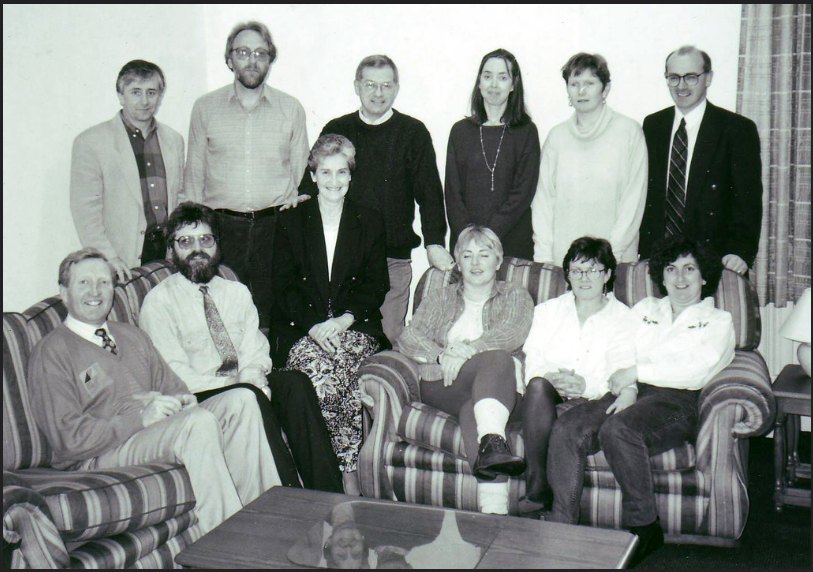
The photograph at the top of this page shows the Conflict Mediation Network — now Mediation Northern Ireland, which started in 1987 as the Northern Ireland Conflict and Mediation Association — staff and committee, around 1994. Standing from left: Martin McAnallen, Steve Williams, Alan Quilley, Sheena Bell, Joan Broder, Brendan McAllister. Seated: Joe Campbell, Jerry Tyrrell, Naomi Lederach, Jenny Marks, Anne Kelly, Clare Morrison.
Growing into the work
Ten years later, staff had grown to around fifteen people and we were involved in key aspects of peacebuilding in Northern Ireland: parades and protests, policing, civic leadership, interface monitoring, and providing a wide range of training to support others to learn the skills they needed in their own contexts. We were in our own building at 83 University Street, opened by the Dalai Lama and Michael Longley.
Our interface monitoring work in East Belfast came at the request of both communities there, and was carried out in partnership with Mary Montague of TIDES and Chris O’Halloran of the Belfast Interface Project. We were looking for ways to show the contribution that creative nonviolent approaches could bring to previously intractable conflicts.

Bringing people through
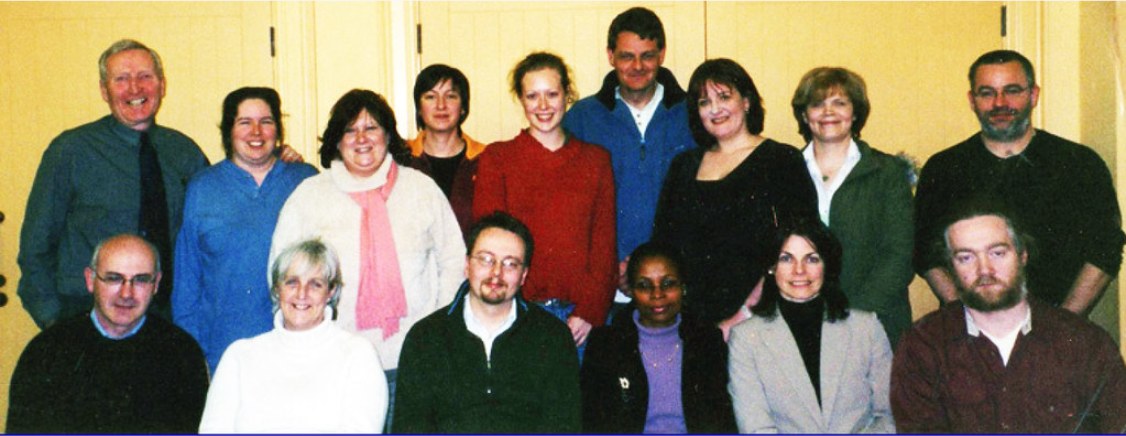
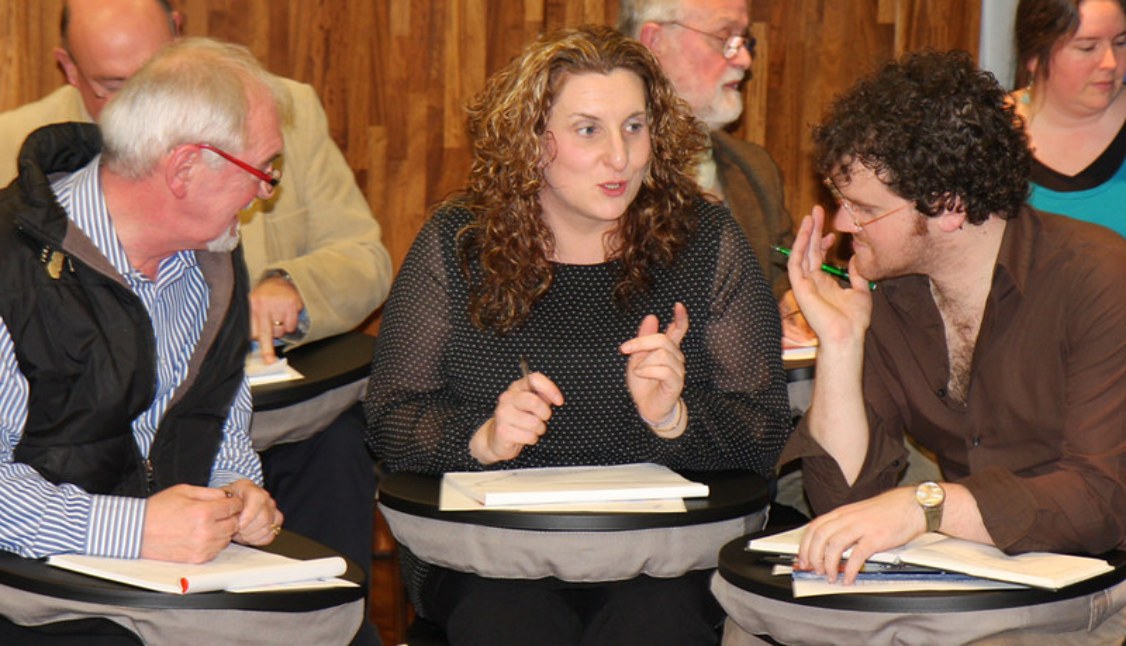
Back in 2010 we were keen to nurture new practitioners through our Next Generation project, supporting those coming to the new challenges of peacebuilding with fresh eyes. Some might spot Enda Young, later to become one of our Directors; the ever-present Rob Colwell; and Stefania Gualberti, who has contributed as a practitioner with Mediation NI for many years.
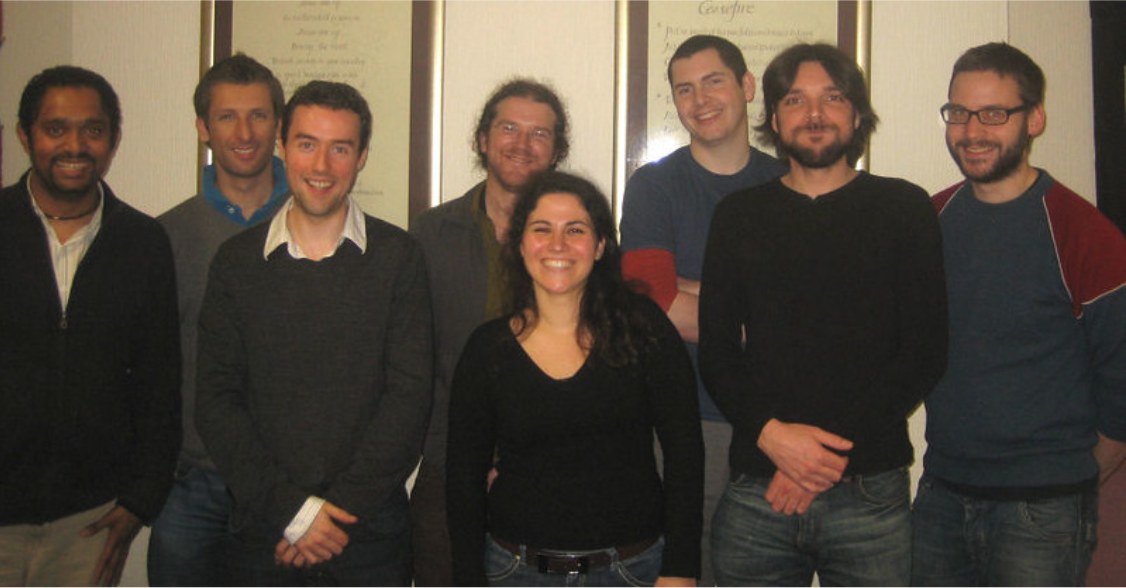
From October 2011 to March 2013 we ran the MOST Programme, providing advanced training in cross-cultural mediation skills alongside an international exchange that gave new practitioners hands-on experience. It also gave us a wonderful opportunity to spend time learning from stars in the field, Sue Williams among them.
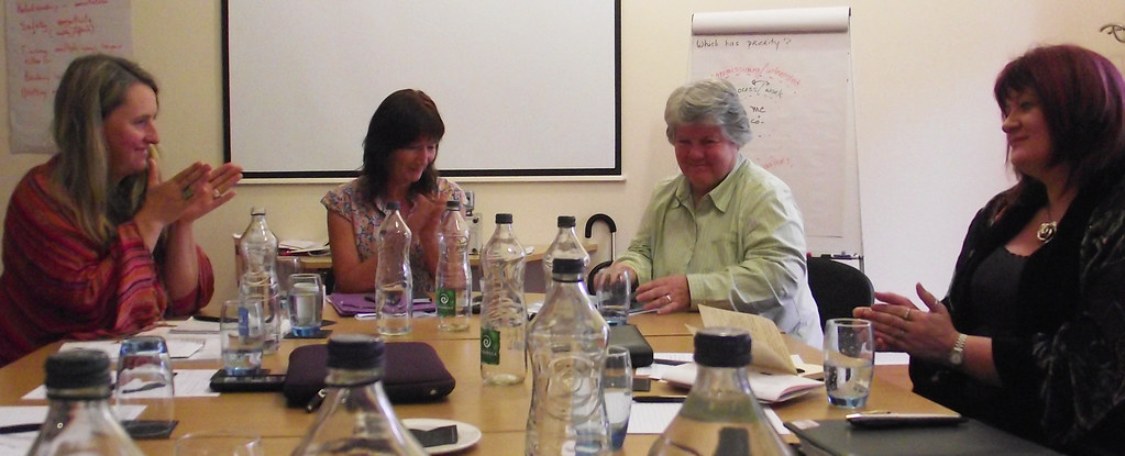
The Big Tea
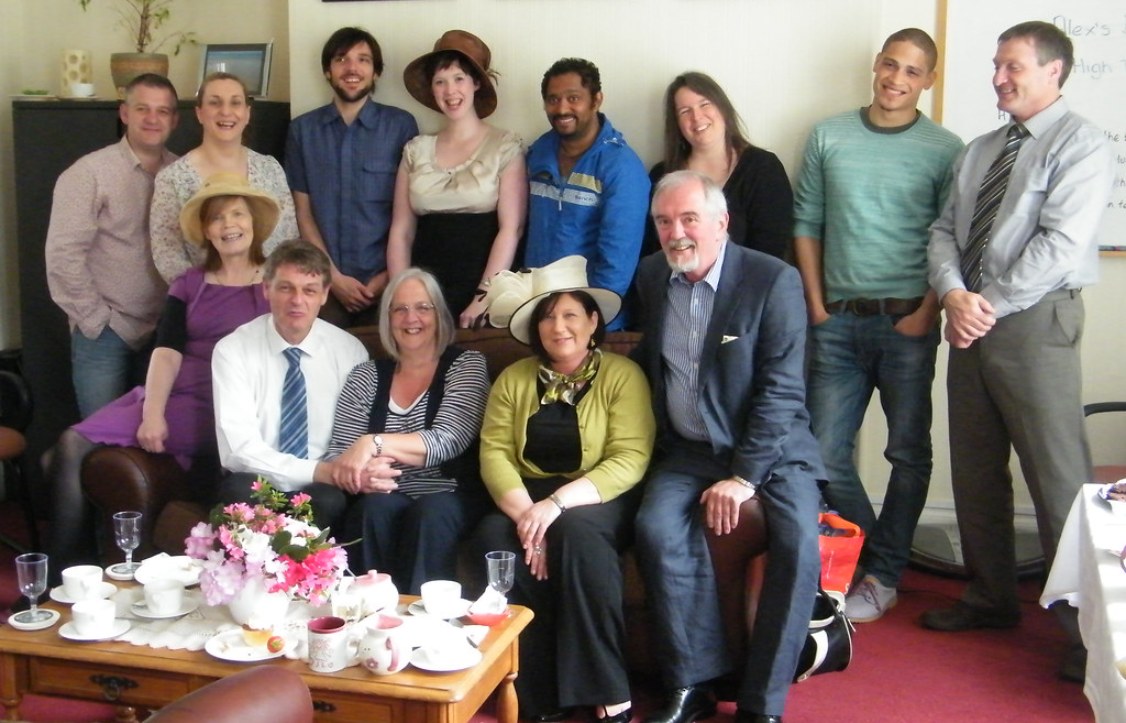
We had many goodbyes over the years, along with a tradition of The Big Tea: a weekly gathering on a Tuesday, when we took time together as a staff body to share and to pay attention to our collective life. For special occasions it was taken up a level with the addition of doilies and big hats. Having fun together was an important antidote to the nature of the work at times.
Those who led
Brendan McAllister was followed as Director by Peter O’Reilly, and Peter’s directorship by a period with Mary Lynch at the helm, alongside Mike Gaston, Pádraig Ó Tuama and Fred Graham, then Mediation NI’s Board Chairperson.
Mary Lynch brought John Paul Lederach back to help us find new direction and encouragement: peacebuilding is a constant process of transformation.
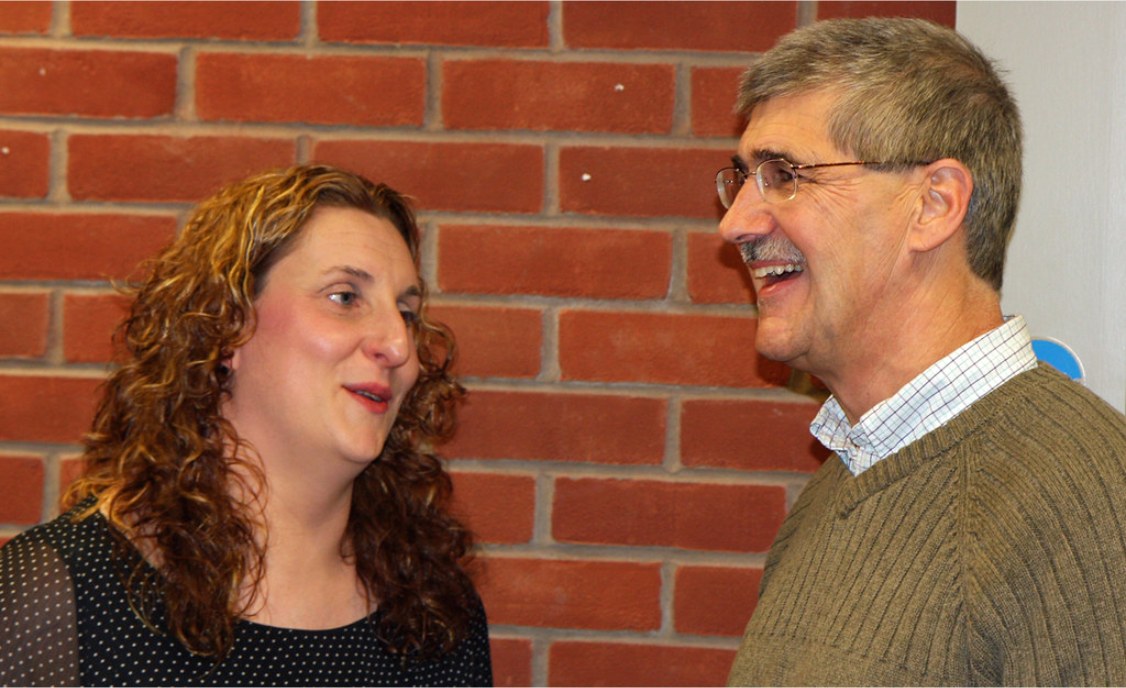
After Mary Lynch, Enda Young was the next Director of Mediation Northern Ireland, working alongside our chairperson at the time, Catherine Turner. He made a valuable contribution to our re-emergence following the covid period, and encouraged us to share our expertise more deliberately in commercial settings.
And one essential word
An essential word about Rob Fairmichael, without whom these archive photographs would be long lost. He has travelled with Mediation Northern Ireland throughout our history, reminding us who we are, and tending the flowers when needed.
Leave a Reply