

Our story
How we got here
Two organisations, founded separately, doing increasingly similar work — and for years already delivering one service together.
Founded on the same premise
TIDES Training & Consultancy was founded in 1998 by Mary Montague and Colin Craig, to embed decades of experience working with communities in divided societies. Mediation Northern Ireland had been established longer still, as a mediation development organisation working across workplaces and communities.
Both were built on the same premise: that the skills for handling conflict can be taught, and that the people closest to a conflict are usually the people best placed to resolve it — if someone gives them a process and holds the room.
Where TIDES came from
TIDES grew out of the Corrymeela Community, where Mary Montague and Colin Craig had been staff, and where generations of people had already been working out what it meant to live together in the middle of conflict. It was built around kitchen tables, out of the stories people told once they felt safe enough to tell them, with one intention from the start: that this work should be open to anyone with the life experience for it, not only to those in a position to study it at university.
The method starts further back than whatever argument is in front of you. It begins with the families, communities, schools, churches and clubs that made us, on the understanding that knowing your own values and identity is what lets you recognise what sets you off. From there the question gets bigger — how do you build the capacity of the people already holding a community together? The answer has always been to work with people rather than do things to them.
The range widened as the organisation did: conflict management and mediation alongside good relations, diversity and equality, restorative practice, trauma-informed practice, leadership and group work. So did the interest in what can be done before a conflict escalates rather than after it. Accredited courses followed, designed with OCN so that people could keep building on what they had already learned and take restorative approaches back into their own schools and organisations.
In 2026 TIDES marked twenty-five years under the theme celebrating the past, embracing the present, looking to the future — honouring where it came from without being defined by it. The anniversary was also for the people who shaped it, among them the late co-founder Mary Montague, whose book was launched that year.
The TIDES milestones
From the TIDES side of the family.
1998
Founded
TIDES established by Mary Montague and Colin Craig, to embed decades of experience working with communities in divided societies.
2000
Charitable status
Registered as a not-for-profit company with charitable status.
2002
An OCN centre
Became an Open College Network approved centre, able to design and award accredited qualifications rather than certificates of attendance.
2009
National Training Award
A UK National Training Award, with The Bytes Project, for a conflict resolution programme addressing anti-social behaviour, sectarianism, racism and anger.
Where Mediation NI came from
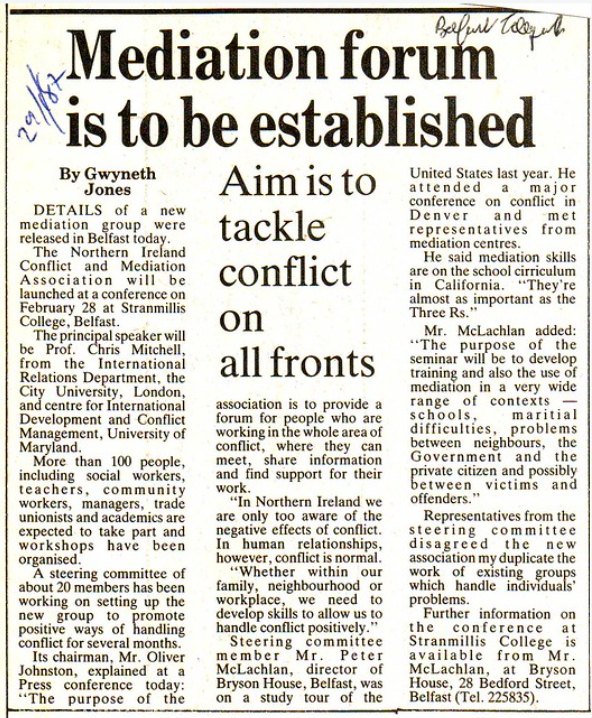
Mediation Northern Ireland began in 1987 as an association of people looking for a different way to handle the conflict around them. It started as the Northern Ireland Conflict and Mediation Association, and its first full-time staff arrived five years later.
Brendan McAllister, the first Director, described how the practice matured over the following decade: it began by importing what American mediators knew, moved through inculturation as Northern Irish language was found for those ideas, then indigenation as a distinctly Northern Irish model was shaped — and arrived at mutuality, ready to open up again to others with something of its own to contribute.
By the mid-2000s the staff had grown to around fifteen, working on parades and protests, policing, civic leadership and interface monitoring, and training others to do the same in their own settings. The organisation had its own building by then — 83 University Street, still its address today — opened by the Dalai Lama and Michael Longley.
That foundation was built by a great many people, among them Adam Curle, Sue and Steve Williams, Mari Fitzduff, Jerry Tyrrell, Doug Baker, and John, Naomi and John Paul Lederach. Many of the early members came through the Corrymeela Community, and brought with them the idea of hosting — that creating the space for an encounter is itself part of the work.
The Mediation NI milestones
From the Mediation NI side of the family.
1987
Founded
Formed as the Northern Ireland Conflict and Mediation Association, by people looking for an alternative to the conflict around them.
1992
First staff
Brendan McAllister and Clare Morrison became the first full-time staff.
2010
Next Generation
A project to bring new practitioners into peacebuilding with fresh eyes — among them people still with the organisation today.
2011
The MOST Programme
Advanced training in cross-cultural mediation, with an international exchange giving new practitioners hands-on experience. Ran until 2013.

We were already working together
Long before the merger, the two organisations jointly delivered the mediation service for the Northern Ireland Housing Executive — covering approximately 89,000 tenants, handling neighbour and community disputes, anti-social behaviour, and racist and sectarian attacks.
They had worked side by side long before that too: MNI’s interface monitoring in East Belfast, requested by both communities there, was carried out with Mary Montague of TIDES and Chris O’Halloran of the Belfast Interface Project.
The merged organisation keeps both inheritances: MNI’s workplace and practitioner development work, and TIDES’ community capacity building and international programmes.
Two organisations that had already spent years working the same ground, and running a major public service between them.
What changes
For clients and communities: very little, deliberately. The same practitioners, the same accreditations, the same phone number. What changes is that there is now one front door rather than two, and one organisation carrying both the commercial and the community work.
Next
Where the work goes now
The merged organisation runs a single training pathway, a single referral route, and a social enterprise arm that funds the community side.